In short
- These Walter Tull facts cover a remarkable life: footballer for Tottenham Hotspur and Northampton Town, then one of the first Black officers in the British Army.
- He was born in Folkestone, Kent, on 28 April 1888, and grew up in an orphanage in London after both his parents died.
- He faced racist abuse from crowds as a player, and kept playing with great dignity.
- He was killed in the First World War on 25 March 1918, aged 29. His body was never found.
- Today he’s remembered with memorials, a blue plaque, a commemorative coin and stamps, and a place in the National Football Museum’s Hall of Fame.
Every October, during Black History Month, children across the UK learn about Walter Tull. His story has everything: football, courage, hardship and a life that still inspires people more than 100 years later.
This guide sets out the key facts in a simple way, so it’s handy for school projects, a family chat or anyone who simply wants to know more.
Walter Tull facts: the quick fact file
| Fact | Detail |
|---|---|
| Full name | Walter Daniel John Tull |
| Born | 28 April 1888, Folkestone, Kent |
| Parents | Daniel Tull, a carpenter from Barbados, and Alice Palmer, from Kent |
| Football clubs | Clapton, Tottenham Hotspur, Northampton Town |
| Army | Middlesex Regiment, including the Football Battalion |
| Became an officer | 30 May 1917, as a Second Lieutenant |
| Died | 25 March 1918, near Favreuil in France, aged 29 |
| Remembered on | The Arras Memorial in France |
Who was Walter Tull?
Walter Tull was a professional footballer and a British Army officer. He is remembered as one of the first Black professional footballers in England, and as one of the first Black men to become an officer in the British Army.
His life is a story about breaking barriers. At almost every step, he faced unfair treatment because of the colour of his skin, and at almost every step, he rose above it.
What was Walter Tull’s childhood like?
Walter Tull’s childhood was hard. His mother died in 1895, when he was seven, and his father died in 1897.
At the age of nine, Walter and his older brother Edward were sent to a Methodist children’s home and orphanage in Bethnal Green, London. Edward was later adopted by the Warnock family in Glasgow, and the brothers were separated.
Edward went on to become a dentist. According to Walter’s biography, he was the first person of mixed heritage to practise dentistry in the UK.
How did Walter Tull become a footballer?
Walter Tull became a footballer by playing for Clapton, a top amateur club in London. In his first season, in 1908, Clapton won the FA Amateur Cup, the London County Amateur Cup and the London Senior Cup.
Tottenham Hotspur soon spotted his talent. He made his Spurs debut on 1 September 1909, aged 21, in a 3-1 defeat at Sunderland. It was Tottenham’s first-ever match in the top division, and the club’s own history describes him as the first Black outfield player to appear in the Football League. He played 10 first-team games for Spurs and scored 2 goals.
In October 1909, during a match away at Bristol City, some of the crowd shouted racist abuse at him. Walter kept his calm and carried on playing. One newspaper report called him the best forward on the pitch, despite the provocation.
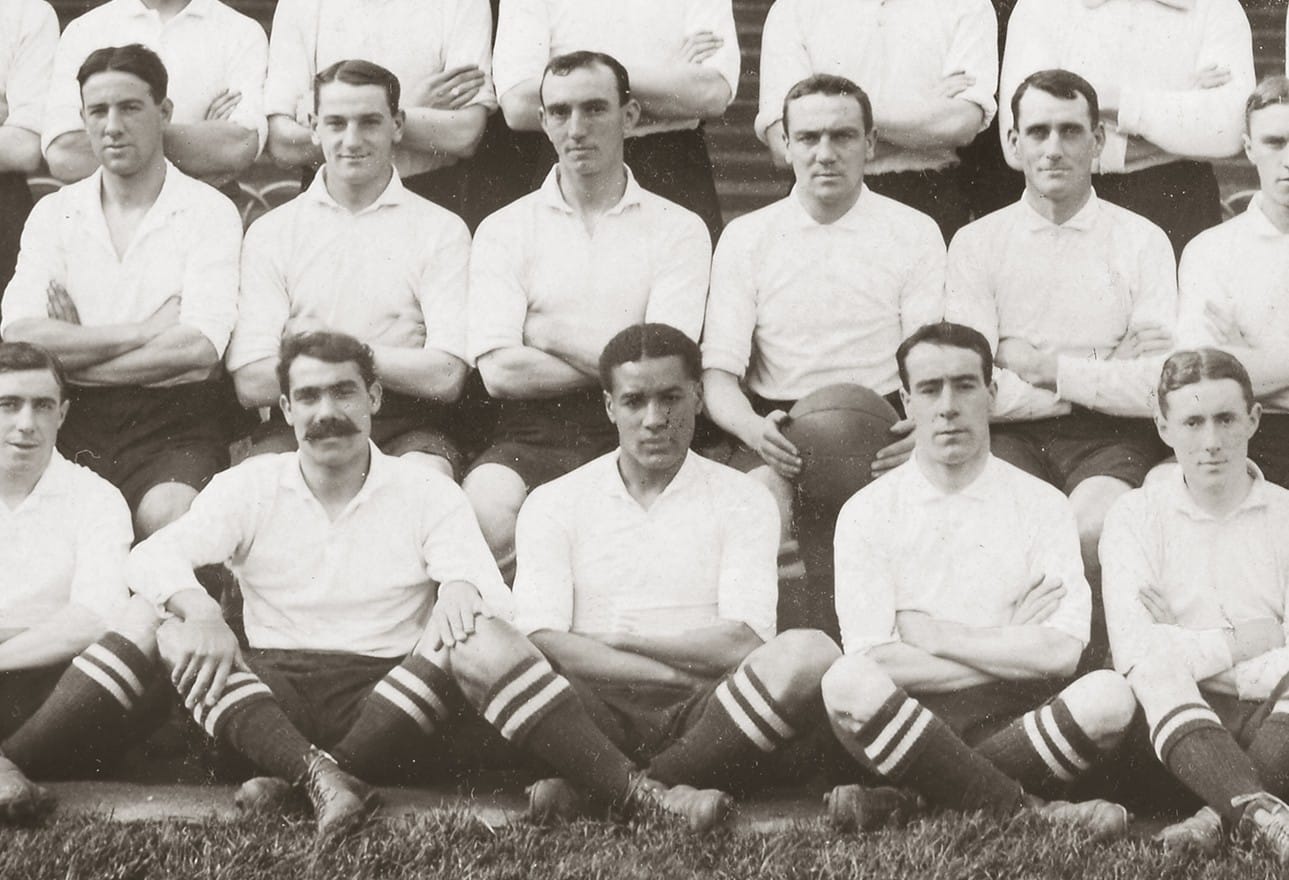
Walter Tull (centre, front row) with Tottenham Hotspur team-mates in 1909, his first season at the club. Image: Wikimedia Commons, public domain.

What did Walter Tull do at Northampton Town?
At Northampton Town, Walter Tull became a regular in the team. He joined in October 1911, after the Northampton manager Herbert Chapman insisted on signing him, and played more than 100 games for the club, which was then in the Southern League.
He usually played at half-back, a midfield position, but he could score goals too. On 14 April 1912, he scored four against Bristol Rovers.
Northampton’s fans have never forgotten him. In 1999, a memorial to Walter was unveiled at the club’s Sixfields Stadium, and a road nearby is named Walter Tull Way. If your child supports the Cobblers, our Northampton Town gifts guide has more about the club.
Walter Tull in the First World War
When the First World War began in 1914, Walter Tull became the first Northampton Town player to join the army. He enlisted on 21 December 1914 and joined the 17th Battalion of the Middlesex Regiment, known as the “Football Battalion” because so many footballers and fans served in it.
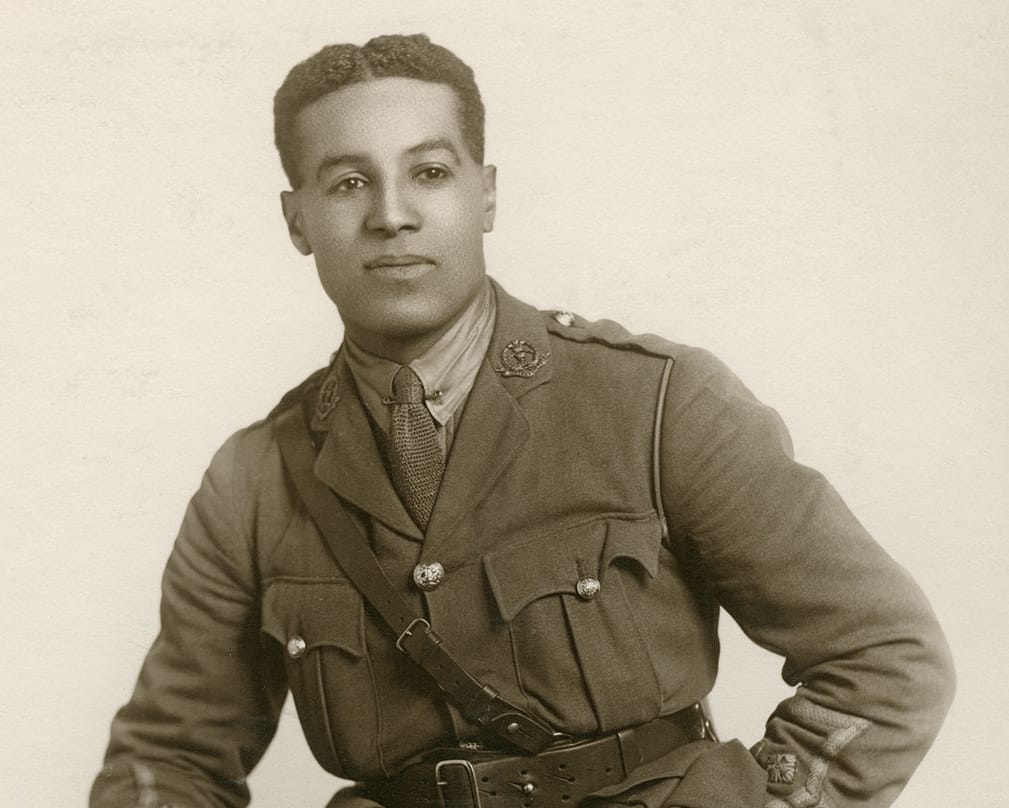
Walter Tull in his officer’s uniform in 1917, the year he was commissioned. Image: Wikimedia Commons, public domain.

He fought in the Battle of the Somme in 1916. The next year, on 30 May 1917, he was made a Second Lieutenant. The National Army Museum describes him as one of the first Black men to receive a commission in the British Army. Tottenham describe him as the first British-born Black combat officer in the British Army. At the time, army rules said officers had to be of “pure European descent”, which makes his promotion all the more remarkable.
He then served in Italy, where he led a group of 26 soldiers on a dangerous night raid across the River Piave. His bravery was praised, and he was recommended for the Military Cross, but he never received it.
How did Walter Tull die?
Walter Tull was killed in action on 25 March 1918, near the village of Favreuil in northern France. He was 29 years old.
He was leading his men across No Man’s Land during the German Spring Offensive of 1918, in fighting known as the Second Battle of the Somme, when he was shot. Soldiers tried to carry his body back under heavy fire, but they couldn’t, and it was never recovered. His name is carved on the Arras Memorial in France, alongside thousands of other soldiers who have no known grave.
How is Walter Tull remembered today?
Walter Tull is remembered in many ways, from football grounds to coins. Here are some of the honours he’s received since his death:
- Northampton Town: a memorial wall at Sixfields Stadium, unveiled in 1999, and Walter Tull Way nearby.
- London: a blue plaque at 77 Northumberland Park, near Tottenham’s ground, unveiled in 2014.
- A £5 coin: the Royal Mint featured him in its 2014 First World War coin set.
- Stamps: Royal Mail put him on a stamp in 2018.
- Hall of Fame: he was inducted into the National Football Museum’s Hall of Fame in 2021.
In 2017, a set of five statues was also unveiled at Northampton Guildhall, part of a project to tell the story of his life.
Walter Tull facts for school projects
If your child is doing a Walter Tull project at school, these are the five facts most worth remembering:
- He was born on 28 April 1888 in Folkestone, Kent.
- He played for Tottenham Hotspur and Northampton Town, and faced racist abuse with great dignity.
- He was one of the first Black officers in the British Army, commissioned on 30 May 1917.
- He was killed in the First World War on 25 March 1918, aged 29.
- He is remembered on the Arras Memorial, and at Northampton Town and Tottenham Hotspur.
A good way to finish a project is to ask a question: what can we learn from the way Walter Tull faced unfairness? There’s no single right answer, and that’s what makes it a great thing to talk about together.
Football heroes on the bookshelf
Stories about real football heroes are a brilliant way to get children reading. If your child loves football, our guide to football books by age has plenty of ideas for every reading level.
And if they dream of pulling on the shirt for their own club one day, our personalised storybooks put them in the starring role, at Tottenham Hotspur, Northampton Town and over 100 other clubs. Every illustration is hand-drawn by a real artist.