
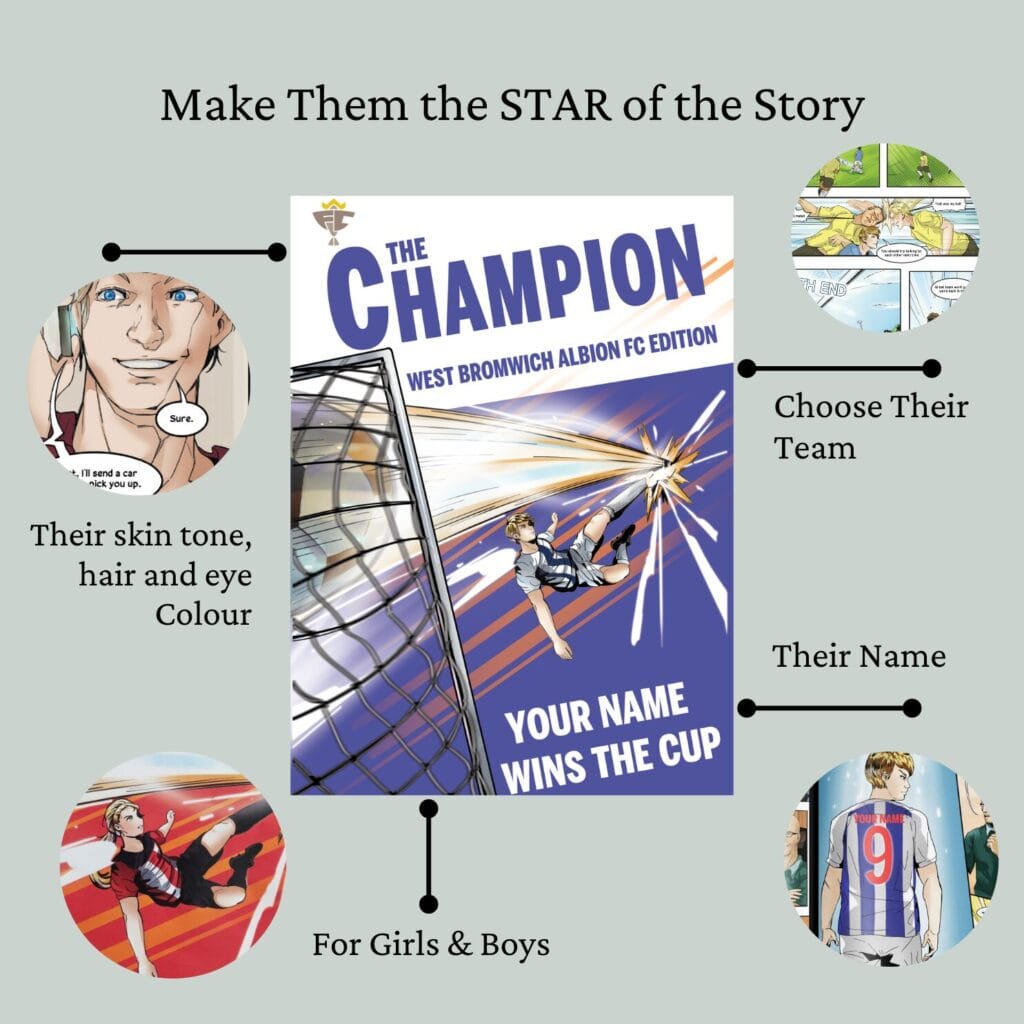
– Personalising a football book means choosing the club, the child’s name and appearance, and a message, then a real artist draws the story to match.
– You can personalise the club, first name, surname, gender, hair colour, skin tone, eye colour, and a message on the inside cover.
– Nothing is generated by software. Every illustration is hand-drawn by a real human artist to match the choices you make.
– The club and the spelling of the name are the two details worth double-checking before you order.
– There is a genuine psychological reason personalisation works this well: people pay more attention to anything tied to their own name.
How Does Personalising a Football Book Actually Work?
Personalising a football book works by choosing a set of options at checkout, then having a real illustrator draw the story around those choices. You are not filling in a template with a photo upload, and you are not waiting for an algorithm to guess what the finished page should look like.
It is closer to commissioning a small, specific piece of work than buying something off a shelf. The club, the name, the appearance and the message all get set before anything is drawn, so the finished book is built around one particular child rather than adapted afterwards.
This matters more than it might sound. Research on customer behaviour consistently finds that customers prefer companies that offer a genuinely personalised experience over a generic one, and a football book personalised properly, not just printed with a name slapped on the cover, is exactly that difference in practice.
It also explains why the order of operations matters. Choosing the club and appearance first, before a single page is drawn, means the illustrator is working from a clear brief rather than retrofitting a name onto artwork that was never built around that child in the first place.
What Can You Personalise on a Football Book?
You can personalise every detail that makes the story feel like it belongs to one specific child. The full list is:
- Football club (Premiership, Championship, EFL League 1, or Ladies Range)
- First name and surname
- Gender of the main character
- Hair colour, skin tone, and eye colour
- A personal message printed on the inside cover
Each of those choices feeds directly into how the illustrator draws the character, not just what text appears on the cover. That is the part that separates a personalised football book from a book with a name printed on the front of an otherwise identical product.
It is worth going through the list slowly rather than rushing it. Club and name are the obvious choices, but the appearance details, hair colour, skin tone, and eye colour, are what actually make the character on the page recognisably the child rather than a generic illustrated placeholder wearing the right shirt.
Is the Illustration Really Drawn by a Human, or Generated by Software?
It is drawn by a real human artist, every time, with no exceptions. This is worth stating clearly, because plenty of personalised children’s book services now work by uploading a photo and letting software generate the artwork automatically.
That is not how this works. Every choice made at checkout, club, name, gender, hair colour, skin tone, and eye colour, goes to an illustrator who draws the character by hand to match. Nothing about the artwork is auto-generated, templated, or produced by an image model.
If you want the fuller story of why that distinction matters and what is happening across the children’s book market more broadly, the human-illustrated explainer covers it in more depth. The short version here: a personalised keepsake deserves a real artist’s attention, not an automated pipeline.
It is a reasonable question to ask of any personalised book, not just this one. Plenty of services in this space now generate artwork from an uploaded photo using software rather than a human hand, and there is nothing wrong with asking directly how a book is actually made before you order one for a child.
Which Club Can You Choose?
You can choose any club across the Premiership, Championship, or EFL League 1, plus the Ladies Range for families celebrating women’s football. That is a wider net than most personalised sports books cast, since many competitors only cover officially licensed partners from the top division.
A child who supports a smaller or lower-league club does not have to settle for a big-name team just because that is what most personalised gifts assume. Whatever club the child actually shouts for on a Saturday afternoon is the one that goes on the cover.
If nobody in the family has settled loyalties yet, matching the club to wherever the child was born, or to whichever team a parent or grandparent already follows, tends to be the easiest default. There is no wrong answer here, and a lower-league club works exactly as well as one of the bigger household names.
How Do You Choose the Right Appearance and Name Options?
Choose whatever matches the actual child, since that is the entire point of the appearance and name options. Match the hair colour, skin tone, and eye colour as closely as you can, and spell the name exactly as the child uses it day to day.
There is real psychology behind why this matters so much. The self-reference effect, a well-documented finding in memory research, shows that people pay more attention to and remember information tied to their own name far better than generic information. A child hearing or reading their own name in a story is not a small novelty, it is genuinely more memorable to them.
The appearance side matters just as much. Research on children’s books has found that when children see themselves reflected on the page, it supports a real sense of identity and belonging, not just a nice-to-have detail.
Worth knowing before you order: hair colour and length are treated as separate things. One reviewer mentioned wanting to customise hair length as well as colour, since their son has longer hair than the standard options show. Hair colour, skin tone and eye colour are all customisable; length currently follows the standard options in the book design choices, so it is worth checking those options before you order if that level of detail matters to you.
Ideas for the Personal Message Inside the Cover
Keep it simple and specific rather than clever. A name, an occasion, and a short line about the club usually works better than anything overwritten. Something like “Happy birthday [name]. Here’s to another season cheering on [club]” does the job without overthinking it.
A few other options that work well: naming who the gift is from, referencing a real match or memory shared together, or a line looking ahead to a season still to come. The message sits inside the front cover alongside the story itself, so it is one of the few details that is entirely personal to your family rather than the club or the character.
Grandparents in particular tend to get real value from this space. A short line about following the same club for years, or a hope that the child will love the game as much as they have, turns a page that could easily be an afterthought into one of the most re-read parts of the whole book.
Whatever you choose, keep it short. The message works best as a genuine line or two, not a paragraph competing with the story for the reader’s attention.
What Happens After You Place Your Order
After you place your order, the details you have chosen go to a real illustrator, and the team keeps you updated as the book comes together. Reviewers consistently mention good communication through the process, being kept informed rather than left wondering what stage their order is at.
Because a real person is drawing every character by hand, rather than a template being auto-filled, a personalised book takes longer to produce than something already sitting on a shelf ready to ship. That is the trade-off for a book that is genuinely built around one specific child rather than assembled from a generic template.
Getting the club and the name spelling right at the point of ordering is the best way to make sure the finished book needs no changes once it is already in production. Everything else, the message, the exact shade of hair or eyes, is easy to describe in your own words when you check out.